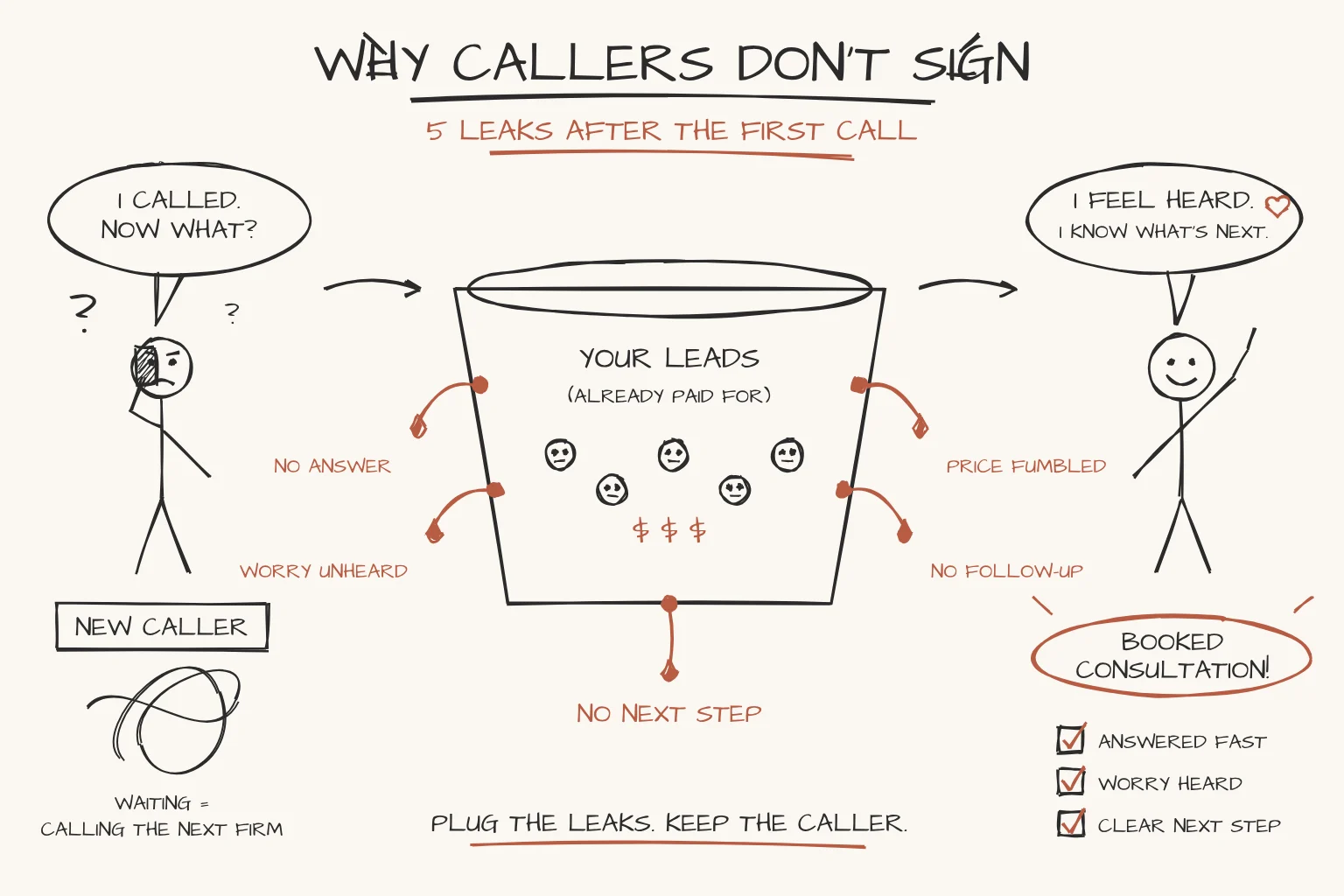
The short answer: law firms lose clients after the first call because the caller doesn't leave feeling heard and doesn't leave with a booked next step. Nobody answers or calls back fast enough, the worry behind the call goes unheard, the price question gets fumbled, the call ends with "someone will reach out," or follow-up stops after "I'll think about it." Any one of those can send a caller to the next firm on their list.
I started at the front desk of an immigration firm. I've taken these calls, I've missed some of them, and later I led the teams that answered them. What I learned is that the people we lose usually weren't lost because of the attorney's skill or the fee. They were lost in a moment that took less than a minute, and nobody on the team knew it had happened.
Key takeaways
- The caller is shopping. Most people call more than one firm. The one that answers, listens and books a time usually wins.
- Speed is the first leak. Every minute between "missed call" and "callback" is time for them to call someone else.
- Empathy is a step, not a tone. Say one specific line about their worry before you ask your first question.
- Price questions are buying signals. Answer plainly, then offer two appointment times in the same breath.
- No call ends without a date. "We'll reach out" is where leads go to disappear.
- "I'll think about it" is the start of follow-up, not the end of the conversation.
The caller is already calling someone else
Picture who is on the other end of the line. For an immigration firm, it's often a wife calling about her husband's status, a son calling because his mother was detained this morning, or someone who has been afraid to make this call for years. They found you on Google, on Facebook or through a cousin, and they found two or three other firms the same way.
Firms underestimate how much of the decision happens before anyone talks about the case. When Clio sent secret shoppers to 1,000 U.S. law firms for its 2019 Legal Trends Report, a person answered only 56% of calls, and more than half of the firms didn't return a voicemail within 72 hours.1 In the 2024 report's secret-shopper study, the share of firms answering the phone had dropped to about 40%.2 Meanwhile, 79% of consumers in Clio's survey said they expect a response within 24 hours.1
That's the bar. It's low, and most firms still trip over it. Which means a firm that simply answers, listens and books a time has a real advantage before anyone says a word about the law.
Leak 1: Nobody answers, or nobody calls back fast
A missed call isn't a lost call yet. A missed call that waits until tomorrow afternoon usually is. The often-cited Lead Response Management study found that the odds of reaching a lead drop dramatically when you wait 30 minutes instead of calling back within five.2 A Harvard Business Review analysis found that companies that responded within an hour were about seven times more likely to qualify the lead than those that waited longer.3
In an immigration firm, the "lead" is a person who just worked up the courage to dial. If they hit voicemail, they don't wait. They try the next number.
What to do:
- Know your real answer rate, including evenings and Saturdays, when many of your callers are off work.
- Set a callback standard your team can hit, ideally within five minutes during open hours, and a first-thing-in-the-morning callback for anything after hours.
- Send a short text right away when a call is missed: "Hi, this is [Name] from [Firm]. Sorry we missed you. I'll call you back in a few minutes. Is this a good number?"
Leak 2: The worry goes unheard
The most common thing I hear on mystery calls is a caller sharing something heavy and the staff member answering with a form question. "My husband has been here twelve years and I don't know if we can fix this." "Okay. What's his date of birth?"
Nobody meant to be cold. The team is busy and they're trained to collect information. But the caller hears that their fear doesn't matter here, and they stop sharing. When they stop sharing, you can't qualify them, and they don't feel safe enough to book.
Empathy on an intake call isn't a soft skill you hope for. It's a step in the call. One specific line, said before the first question:
Instead of"Okay. What's his full name and date of birth?"
Try"That sounds like a lot to carry. You did the right thing by calling. Can I ask a few questions so I can get you to the right person?"
Be careful with comfort that turns into a promise. "Don't worry, we fix these all the time" feels kind, but it sets an expectation no one at intake can make, and it skips over what the caller actually said. Acknowledge the feeling, not the outcome.
For Spanish- and Portuguese-speaking callers, this matters even more. A caller who has to switch languages to explain the worst thing in their life will often say less. If you have bilingual staff, route those calls to them first. If you don't, say it out loud: "I want to make sure you're understood. Would you be more comfortable in Spanish? I can have [Name] call you back today."
Leak 3: The price question gets fumbled
"How much is this going to cost?" usually comes early, and it's where a lot of calls quietly end. There are two common fumbles. The first is the dodge: "I can't say, the attorney will tell you." The caller hears that you're hiding something. The second is the lecture: five minutes on fee ranges before anyone understands the case. The caller hears a big number and no plan.
A price question is a buying signal. People don't ask what it costs unless they're picturing hiring you. Answer what you can answer, and move straight to the next step:
Try"Good question. The consultation is [$ amount], and the attorney will give you the full fee once they understand your case, so there are no surprises. I have Thursday at 10 or Friday at 2. Which works better for you?"
If your firm offers payment plans, say that they exist. Don't build the plan on the intake call, and never mention an option your firm doesn't actually offer.
Leak 4: The call ends without a next step
This is the leak firms are most surprised by when they hear their own calls. The conversation goes well. The caller is warm. And then it ends with "Someone from our office will reach out to you," or "Call us back when you're ready to book."
From the caller's side, that's not a next step. It's homework. They hang up, the kids need dinner, and the other firm that offered a time on Thursday gets the appointment.
Every qualified call should end with three things:
- A specific time. Offer two options, not "When are you free?"
- A confirmation they can see. A text or email while you're still on the phone, with the date, the address or link, and the attorney's name.
- What to bring. A short list of documents, so the consultation can move forward instead of starting over.
Leak 5: Follow-up stops at "I'll think about it"
"I need to think about it" or "I need to talk to my husband" are normal. Big decisions take a conversation at home. The leak isn't the hesitation. The leak is when the firm says "No problem, call us when you're ready," and that's the last anyone hears from them.
Find out what's really in the way, and agree on when you'll talk again:
Try"Of course. This is a big decision for your family. Is it the amount or the timing that feels hardest right now? Let's do this: I'll call you Thursday at 6, after your husband is home, so you can both ask your questions."
Then build follow-up so it doesn't depend on someone remembering. A reasonable baseline: a callback within minutes of a missed inquiry, a second try within a few hours, a short text or email the same day, and active touches through the first week. Log every attempt in your CRM with an owner and a next action date. The same goes for no-shows: a caller who missed a consultation is still a caller who wanted help.
How to find your own leak this week
You don't need a new system to start. You need to listen.
- Pull five to ten recent intake calls. Mix booked and not booked.
- Mark the moment each one changed. Was it the wait, the first question, the price, the ending or the follow-up?
- Track five numbers, separately: answer rate, time to callback, booking rate, show rate, and consultation-to-signed rate. A strong booking rate with a weak show rate is a different problem from a weak booking rate.
- Fix one leak at a time. Write the words, practice them out loud as a team, and listen again in two weeks.
When we did this inside one 8-figure immigration firm, conversion went from 17% to 38% in six months and reached 46% at twelve months. It wasn't a magic script. It was the same team fixing these moments, one at a time, and measuring what changed. Results vary by firm, and I'll always tell you honestly what I hear.
Want to know what your callers actually hear?
We'll call your firm as a real prospect would, then send you a scorecard of every moment above, before any conversation about working together.
Request a free mystery call →Frequently asked questions
Why do law firms lose clients after the first call?
Usually not because of the law. Callers slip away in five moments: nobody answers or calls back fast, their worry goes unheard, the price question gets fumbled, the call ends without a booked next step, or follow-up stops after "I'll think about it."
How fast should a law firm call back a new lead?
As close to five minutes as you can. Lead-response research has found that the odds of reaching someone drop sharply after the first few minutes, and a caller who is shopping will often call the next firm while they wait.
What should intake staff say when a caller asks about price?
Acknowledge the question, give the consultation fee plainly, explain that the attorney gives the full fee once they understand the case, and offer two specific appointment times in the same breath.
How do I find out where my firm is losing callers?
Listen to five to ten recent intake calls and mark the moment each one stalled. Then track answer rate, speed to callback, booking rate, show rate and consultation-to-signed rate separately, so you can see which stage is leaking.

Maria Cerrillo
Maria started at the front desk of an immigration law firm and worked through paralegal work, business development, marketing and firm leadership. She founded The Maria Method Co. to help immigration firms turn more callers into signed clients. She works in English, Spanish and Portuguese.
- Clio, "Clio's Legal Trends Report Reveals Law Firms Struggle to Respond to Client Inquiries" (2019 Legal Trends Report).
- American Bar Association, Law Practice Magazine, "Law's New First Impression: Transforming Client Intake" (March/April 2025), citing the 2024 Clio Legal Trends Report and the Lead Response Management study.
- Oldroyd, McElheran and Elkington, "The Short Life of Online Sales Leads," Harvard Business Review, March 2011.
This article is about client experience and intake, not legal advice.